System Design Game
Keep It Online
Learn system design by keeping a backend online.
Traffic grows, dependencies slow down and payments lose their confirmations. You choose what to deploy, then use the metrics and request traces to understand the result.
Sign in to save progress across devices.
From problem to decision
Inspect. Deploy. Measure.
Inspect the problem
Read the objective, inspect components and trace a request. Find the bottleneck before spending your credits.
Make an architecture decision
Compare the available options and deploy a change. Each choice changes how the simulated backend behaves.
Learn from the result
Watch latency, queues and cost. Review the measured effects, or retry the level with a different approach.
The campaign
Start small. Keep growing.
Start with the controls, then solve a different backend problem in each level. Your result explains what changed and why.
- 00
Learn the controls
Inspect a server, deploy a change and observe the request queue.
- 01
Scale Out
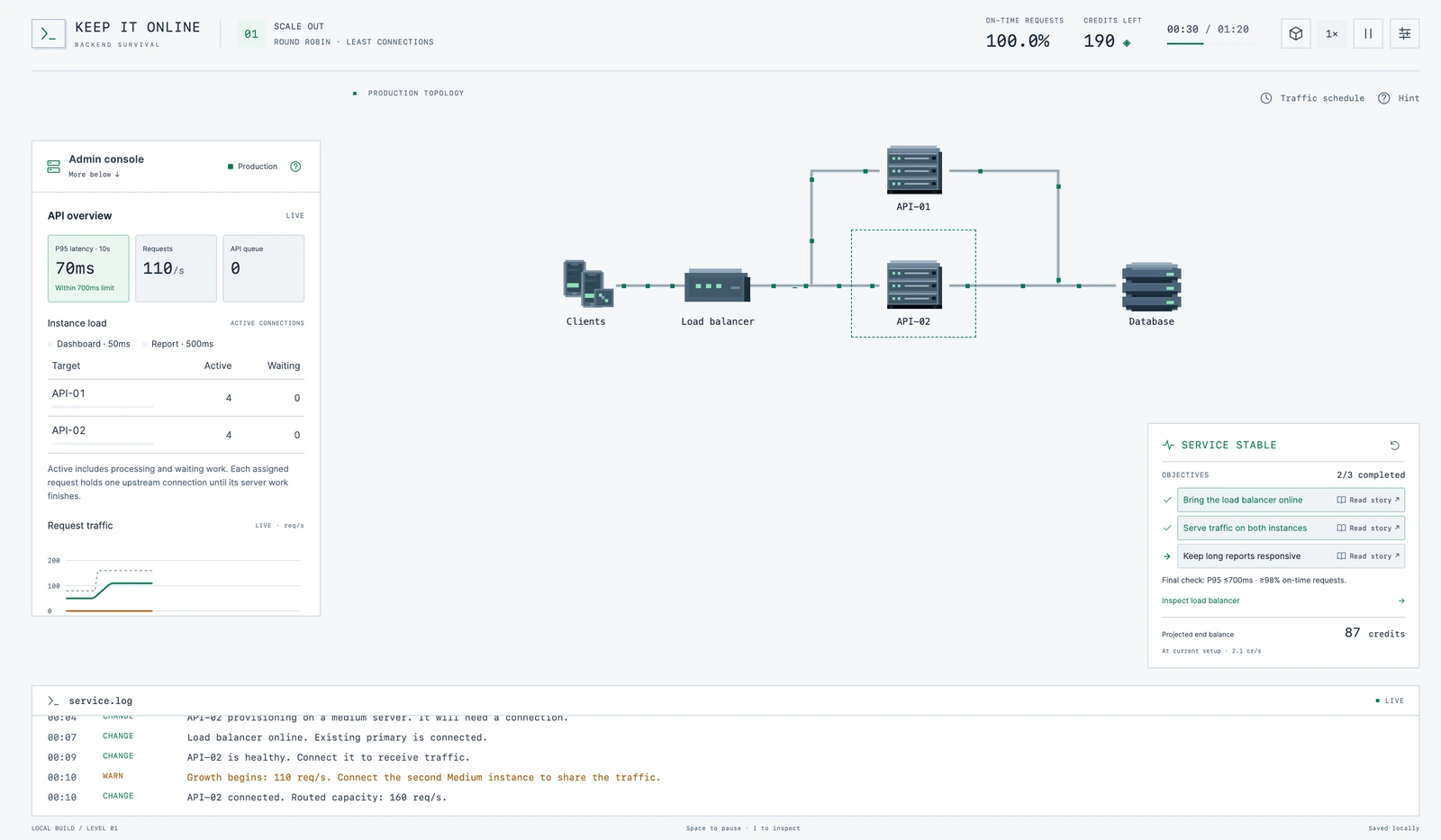
Balance fast requests and longer reports. Compare Round Robin with Least Connections.
- 02
Read Storm
Find the shared database bottleneck and measure what a cache actually changes.
- 03
The missing confirmation
Retry a payment after a lost response without charging the customer twice.
- 04
The webhook backlog
Keep checkout fast with a queue, then recover deliveries that keep failing.
- 05
Noisy Neighbor
Limit one merchant’s traffic without rejecting legitimate bursts from everyone else.
- 06
A dependency goes down
Contain a slow provider with timeouts and a circuit breaker, then recover.
- 07
Event History
Handle read surges and growing writes with caching, read replicas and sharding.